Operlity's data governance capability gives organizations a unified, governed data layer across their entire GRC program — a single repository for every file, document, and dataset, and a single API for cross-platform data access, reporting, and dashboarding.
Data governance in GRC environments fails not because organizations don't care about their data — but because their platforms weren't designed to govern it:
evidence files, workpapers, risk documents, and attachments scattered across multiple tools and shared drives with no unified governance layer
reporting and dashboards built from data pulled from disconnected systems, producing inconsistent results that nobody fully trusts
files uploaded to different parts of a GRC program with no consistent classification, access control, or retention policy applied
connecting GRC data to external systems and customer applications requires custom integrations that are expensive to build and hard to maintain
no unified record of who uploaded what, when, and in what context — making evidence traceability a manual and unreliable exercise
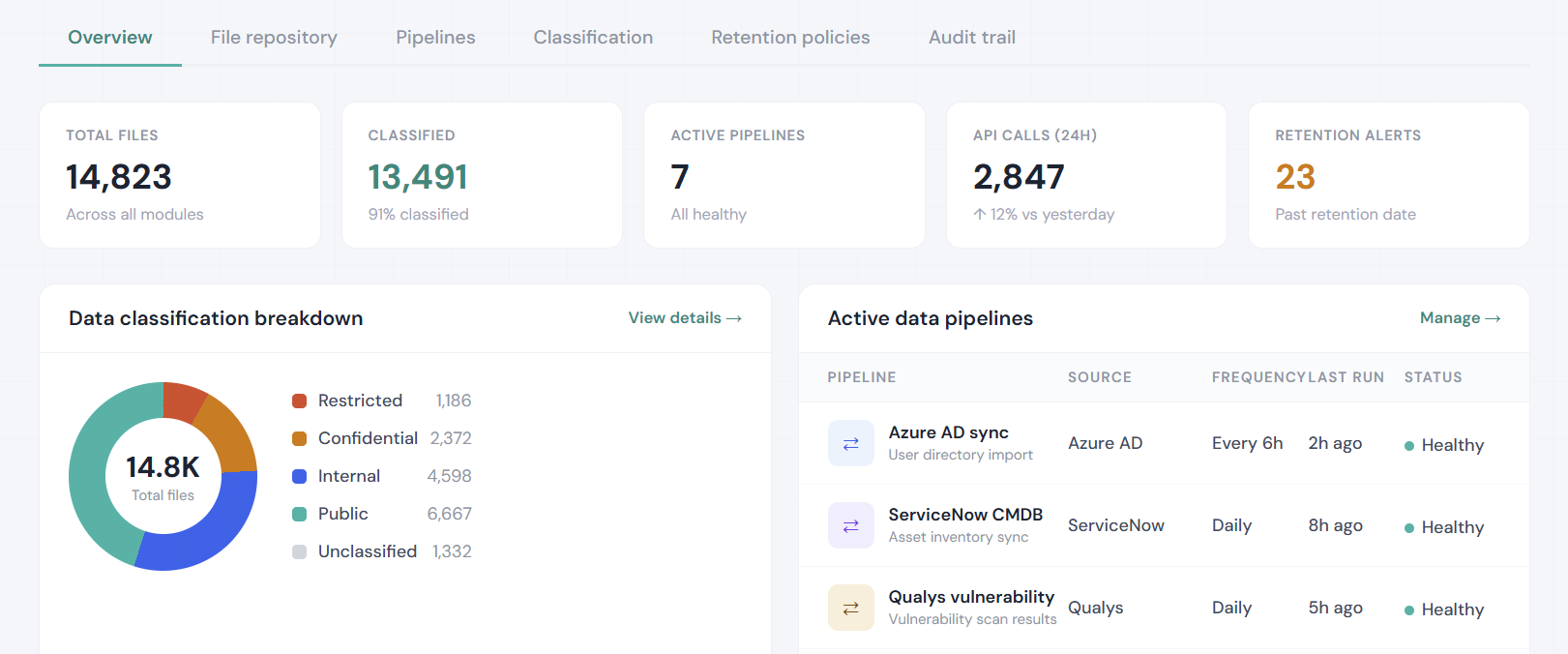
DataHub — that serves as the single repository and API for all data and documents across the platform. Every file uploaded anywhere on the platform, every dataset generated by any application, flows through one governed, auditable, and accessible data infrastructure.
every file attached to a risk, uploaded as audit evidence, added to a workpaper, or submitted through any Operlity application is stored in a single, governed repository — with consistent classification, access controls, and audit trails applied automatically
a unified API layer enables any Operlity application — GRCHub, and others — to retrieve and exchange data consistently, eliminating silos and ensuring every part of the platform works from the same data foundation
DataHub connects to customer applications and external systems through its data pipeline capability, pulling external data into the platform for unified assessments, reporting, and dashboarding
because all data flows through a single governed layer, reports and dashboards across the platform draw from one consistent, trustworthy source — eliminating the discrepancies that plague multi-tool GRC environments
apply classification, access controls, retention policies, and audit trails at the data layer — so governance is built into how data is handled, not bolted on afterward
| Feature | Description |
|---|---|
| Unified File Repository | Single governed store for every file, document, and attachment across the entire Operlity platform |
| Single Data API | One API interface for all data access, retrieval, and exchange across Operlity applications |
| External Data Pipelines | Connect to customer systems and third party applications to pull data into the platform for unified analysis |
| Cross-Platform Reporting | Unified reporting and dashboarding drawing from a single, consistent, governed data source |
| Data Classification & Access Controls | Apply classification tags and role-based access controls at the data layer across all platform content |
| Full Audit Trail | Complete, tamper-evident record of every file upload, data access, and document action across the platform |
GDPR DPDPA ISO 27001 PCI DSS HIPAA PDPL Operlity's unified data layer makes data governance requirements across privacy and security frameworks significantly easier to meet — with classification, access controls, retention, and audit trails built into the platform architecture.
level governance — data governance in Operlity isn't a module or an add-on; it's built into the platform architecture so every application benefits automatically without additional configuration
a single data API means every part of the platform works from the same governed data foundation, eliminating the inconsistencies that undermine trust in GRC reporting
the ability to pull data from customer systems and third party applications means your GRC program can incorporate the full breadth of your data landscape, not just what lives inside the platform