Operlity's Enterprise Context Management gives your organization a single, structured view of every business process, application, technology asset, and infrastructure component and therefore serving as the contextual foundation for your GRC program and an enterprise architecture tool for teams practicing EA frameworks.
Governance, risk, compliance, and enterprise architecture all depend on the same foundational question: what does this organization actually consist of? Yet in most organizations, this information is scattered, incomplete, and maintained differently by every team that needs it.
Business processes, applications, and infrastructure tracked in disconnected tools, spreadsheets, and tribal knowledge with no unified, governed view.
Systems and services in use that nobody has formally catalogued, assessed, or assigned ownership to.
Auditors ask for asset lists and application registers that don't exist or are out of date.
Enterprise architects lack a structured, current view of the application portfolio, technology standards, and business capability landscape they're designing for.
Architecture artifacts live in one tool, risk data in another, and compliance evidence in a third — with no traceability between them.
No clear visibility into how a change in one system impacts connected processes, data, controls, or architecture decisions.
Organized across the dimensions that matter to both GRC and enterprise architecture practitioners.
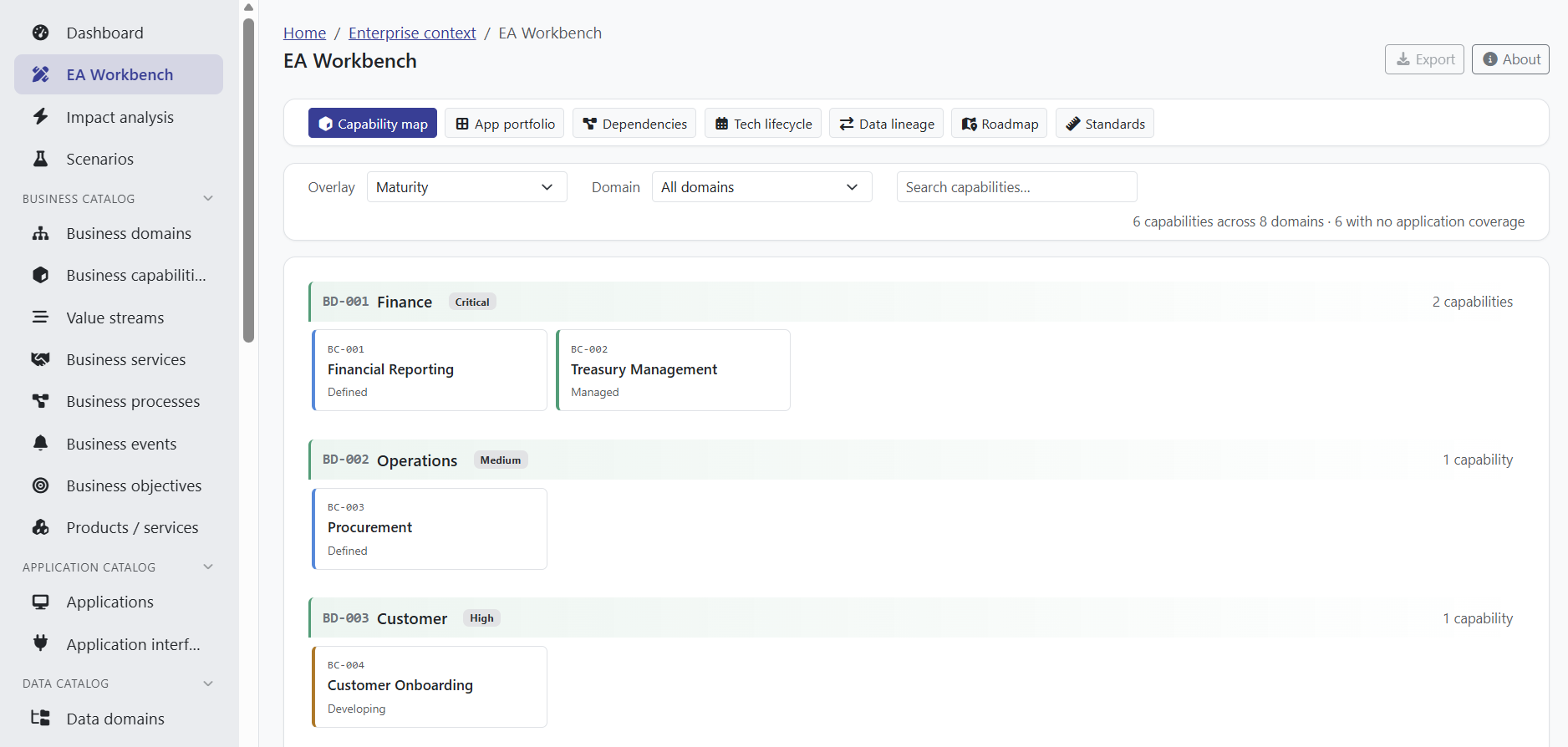
Document and link your business processes, objectives, products, and services to the systems and assets that support them. Model business capabilities with maturity scoring — creating traceability from strategy through operations to infrastructure.
Maintain a live inventory of information assets, applications, databases, and cloud services — with ownership, classification, risk attributes, and lifecycle status. Track application lifecycle stages from Plan through Build, Deploy, Operate, and Retire.
Catalog facilities, locations, data centers, and IT devices — so your physical footprint is as governed and visible as your digital one.
Maintain a governed technology standards catalog — classifying technologies as Approved, Emerging, Retiring, or Retired — so architecture and engineering teams make technology choices aligned to organizational standards.
Understand how entities connect — a business capability supported by an application, dependent on a database, running on a cloud service, governed by a policy. When something changes, the downstream impact is immediately visible.
| Feature | Description |
|---|---|
| Unified Context Registry | One place to view and manage all enterprise entities across business, technology, and physical dimensions — serving GRC and architecture teams from the same data |
| Business Capability Modelling | Define hierarchical business capability maps with maturity scoring and target state tracking — a foundational practice for TOGAF and other EA frameworks |
| Application Portfolio Management | Track application lifecycle status (Plan → Build → Deploy → Operate → Retire) with ownership, technology fit, and risk attributes — giving architecture teams a governed portfolio view |
| Technology Standards Catalog | Classify technologies as Approved, Emerging, Retiring, or Retired — so architecture decisions and engineering choices align to organizational standards |
| Technical Debt Register | Identify and track technical debt items with severity, ownership, remediation plans, and linkage to affected applications and technology assets — making technical debt visible and manageable |
| Relationship & Dependency Mapping | Map relationships between business capabilities, applications, data assets, infrastructure, and controls — so impact analysis is immediate when something changes |
| Ownership & Accountability | Assign owners to every entity in the context model — so responsibility is always clear for both governance and architecture purposes |
| Risk & Classification Attributes | Tag assets with sensitivity, criticality, lifecycle status, and risk ratings — enriching the context model for both GRC and EA decision-making |
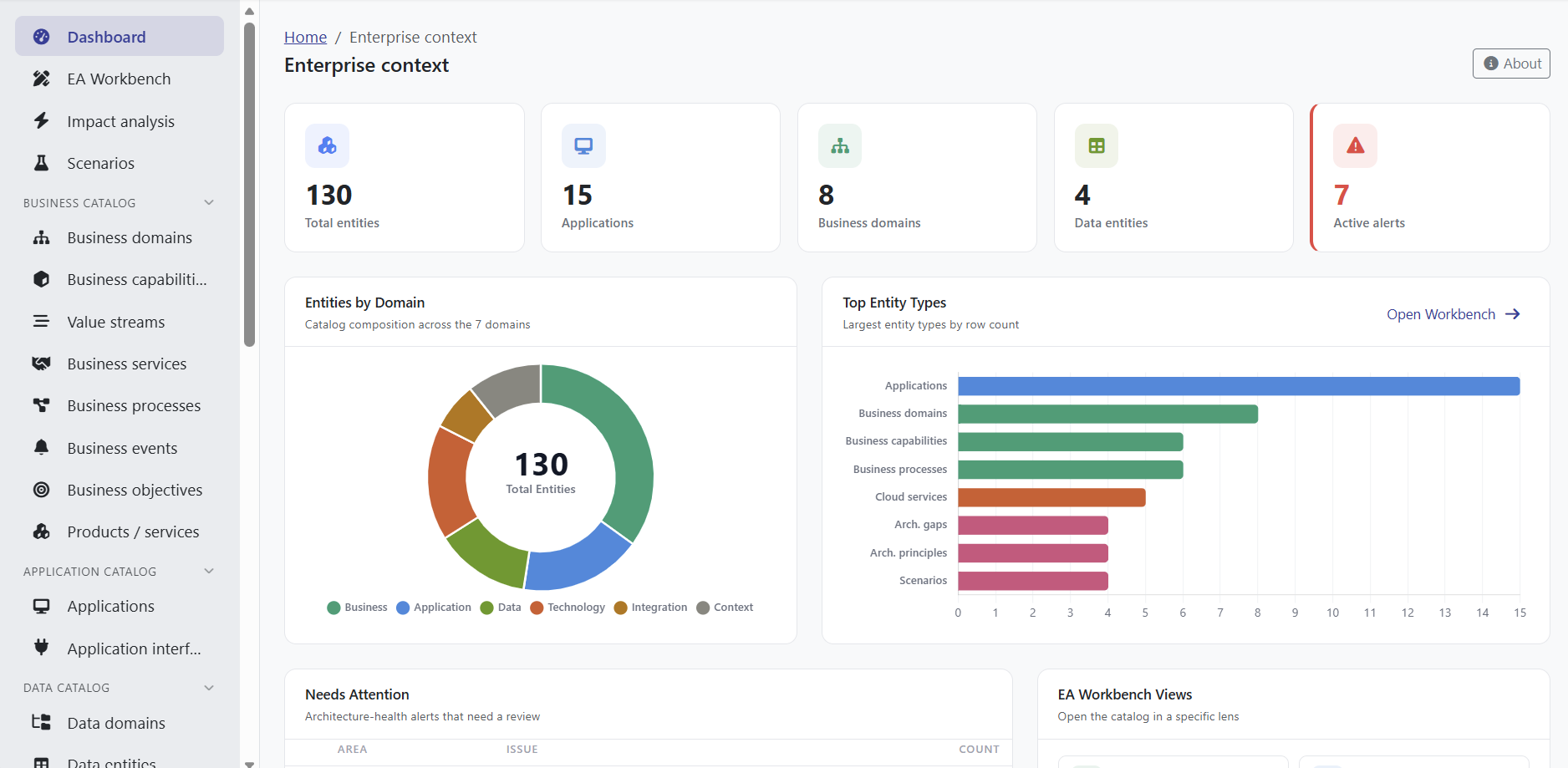
| Architecture Portfolio Dashboards | Visualize application portfolio health, technology standards compliance, capability maturity, and technical debt status — giving architecture teams the oversight they need |
Enterprise Context Management serves as a practical tool for enterprise architects — particularly those practicing TOGAF — without the complexity and cost of a full-suite EA platform.
Enterprise Context Management is not a replacement for full-suite EA tools like LeanIX or Ardoq. It doesn't include visual roadmap management, formal ADM stage-gate governance, or architecture pattern repositories. It is a lightweight, practical, governed context model that gives EA practitioners the structured foundation they need — and connects that foundation directly to the organization's GRC program.
A well-maintained enterprise context model is a foundational requirement for compliance across virtually every major framework. Operlity maps your enterprise context directly to the controls and obligations that apply.
Deployment: cloud, on-premises, or hybrid — your data, your environment, your terms.
Most organizations maintain separate inventories for GRC and architecture purposes, creating duplication and inconsistency. Operlity unifies both — so architecture decisions and governance activities work from the same data.
Enterprise architects get capability modelling, application portfolio management, technology standards governance, and technical debt tracking — without the complexity, learning curve, and cost of a dedicated EA suite.
Every entity in the context model is connected to risks, controls, compliance obligations, policies, and audit evidence — so your context model actively powers your governance program, not just your architecture practice.